The #edenproject is one of the most popular tourist attractions in Cornwall, and for good reason! A dazzling showcase of incredible plants from across the world, it is a must-see for anyone interested in botany (and anyone with a fondness for amazing ice-cream!).
Gumnut correspondent Ben spent a week in June 2021 roaming Cornwall, ostensibly on holiday but really just looking for #eucalyptus.
(right) What is that looming over the horizon?
Whilst you might expect eucalyptus to be found within the incredible geodesic biomes, the majority are actually outside! I did take some photographs of the eucs in the Mediterranean biome, but the focus was unfortunately a bit off. If nothing else it gives me an excuse to go back! Cornwall is perhaps the easiest place in the UK to grow eucalyptus, with a wonderfully mild climate.
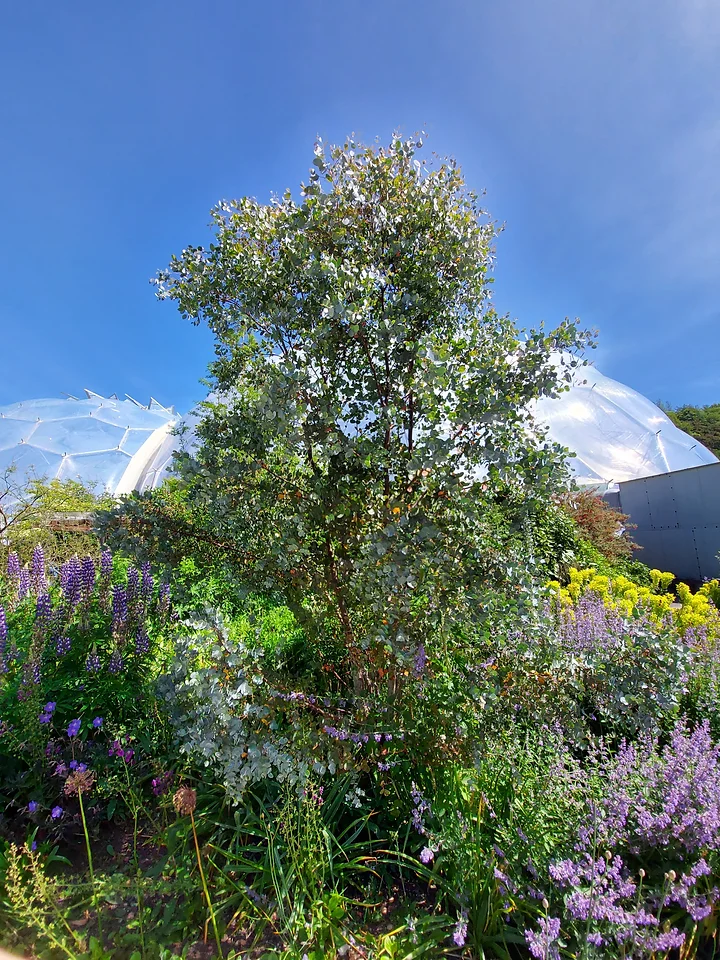
Here we have a wonderfully bushy species that appears to be a
#gunnii type. It might be a standard gunnii that is exceptionally well pruned, or it might be one of the popular dwarf varieties such as
Azura or
Silverana.
Gunnii is a very hardy species that grows pretty much anywhere, even in Scotland. It is also quite easy to grow and train, which is why you will almost always find it in your local garden centre. Some sellers are a bit unethical in their marketing, and will describe it as reaching 10 meters. It will reach 10 meters, on the way to being 25 meters tall! Without a label it can be very difficult to differentiate between different gunnii types, the best indicator will be growth rate – gunnii can grow two meters in a year!
Dwarf gunnii cultivars like Azura and Silverana are an appealing combination of the best traits of gunnii (hardiness, fragrance, and the classic foliage) in a smaller package that is significantly easier to manage. Also keep an eye out for gunnii divaricata. Often marketed with the name ‘Blue Ice’ for no better reason that sounding cool (it does admittedly sound rather cool), it is almost identical to gunnii in growth habit. Eucalyptus archeri is a member of the gunnii family that sits between the dwarf varieties and your standard gunnii.

In the same part of the Eden Project we also have this lovely
Eucalyptus crenulata. The eucalyptus in these photographs are interesting because they dispel the long standing myth that you can’t plant anything underneath eucalyptus trees. I’ll be writing a much longer blog post on common eucalyptus myths soon, but the idea that a eucalyptus will somehow poison the soil around it just isn’t true. Some species of tree such as Yew are capable of allelopathy (producing biochemicals to suppress the growth of competing plants), but none of the eucalyptus that are capable of growing in the UK appear to have this trait. Indeed, in the early years after planting it is usually a bigger challenge to
suppress any weeds around a newly planted eucalyptus. I suspect that this myth arose because of observations that the ground flora is quite limited in eucalyptus plantations and forests. This is because eucalyptus are similar to native species like beech, in that they are very effective at closing the canopy and taking up all the available light. This is much less of a problem when you have a single eucalyptus in your garden.
When exploring the Eden Project it is easy to miss this wonderful little grove of mature eucalyptus tree. I suspect they are gunnii type (identifying mature eucs can be more tricky than with juveniles, particularly when the leaves are so far away!). Located just beyond the Mediterranean biome, you can easily see the trees standing proud of their neighbours. There is a path of sorts leading up to them, it is worth a detour.
UPDATE: I have been informed by Hilary that they are Eucalyptus globulus!
The eucalyptus at the Eden Project are a wonderful illustration of their many forms and uses. Whether they’re being kept as a bushy shrub, an elegant multistem, or a towering standard tree, they are gorgeous evergreen trees – more than hardy enough for much of the UK. Keep them in mind when you next visit!