

Receive a 20% Discount Off all trees when collected from the nursery, A collection time must be arranged with the nursery before travelling. Discount IS NOT applicable to sundries. Use code: collect2023 Dismiss
This guide covers:
The Privacy Panic: Why Most Evergreen Trees Fall Short
So you’ve woken up one morning, discovered that you suddenly don’t like looking at that offensive, red-brick gable end of the property opposite. Or, to your horror, a neighbour has had a dormer window sprout (seemingly overnight) on the back of their house and it’s looking right down into your oasis of calm! When did that happen?
Feeling comfortable in your garden, so that you are not being overlooked or, even worse, being actively watched is vital for the enjoyment of being outdoors in your private space; your decompression space.
In any event, you’ve made a decision: you need a fast-growing privacy screening tree. for your small garden.
You need something evergreen. If you choose a deciduous tree, autumn will arrive, the leaves will fall, and you’ll be right back where you started: the nosy neighbour, the offending sight, but now irritatingly viewed through a set of bare twigs.
How quickly do you want this screen? Now that you have made the decision, you want it… well NOW!
There are a number of evergreen trees that will do the job for you, but many have drawbacks; a major point is their painfully slow rate of growth.
If speed is your need and you want something fairly instant and large, you could cash in your premium bonds and obtain a behemoth of a specimen from a specialist nursery OR choose a fast-growing species, but not something that will grow into an 80ft monster; not in your lifetime anyway.
The knee-jerk reaction for some gardeners is to buy Eucalyptus gunnii, the Cider Gum that has given its entire family a bad name. Evergreen, fast growing – ticks all the boxes, except that it doesn’t if you plant and then ignore your tree for a few years.
You’ll only be disappointed as Mr E. Gunnii rapidly reaches for the skies and provides a fleeting distraction from that annoying dormer window, as his sparse, willowy, blue foliage wafts in the breeze. That is before you call the tree surgeon to have Mr Gunnii removed, as he quickly heads for 80ft tall.
Fortunately, there are 30 hardy smaller Eucalyptus species and cultivars in the UK, that are perfect for privacy screening in the average domestic garden.
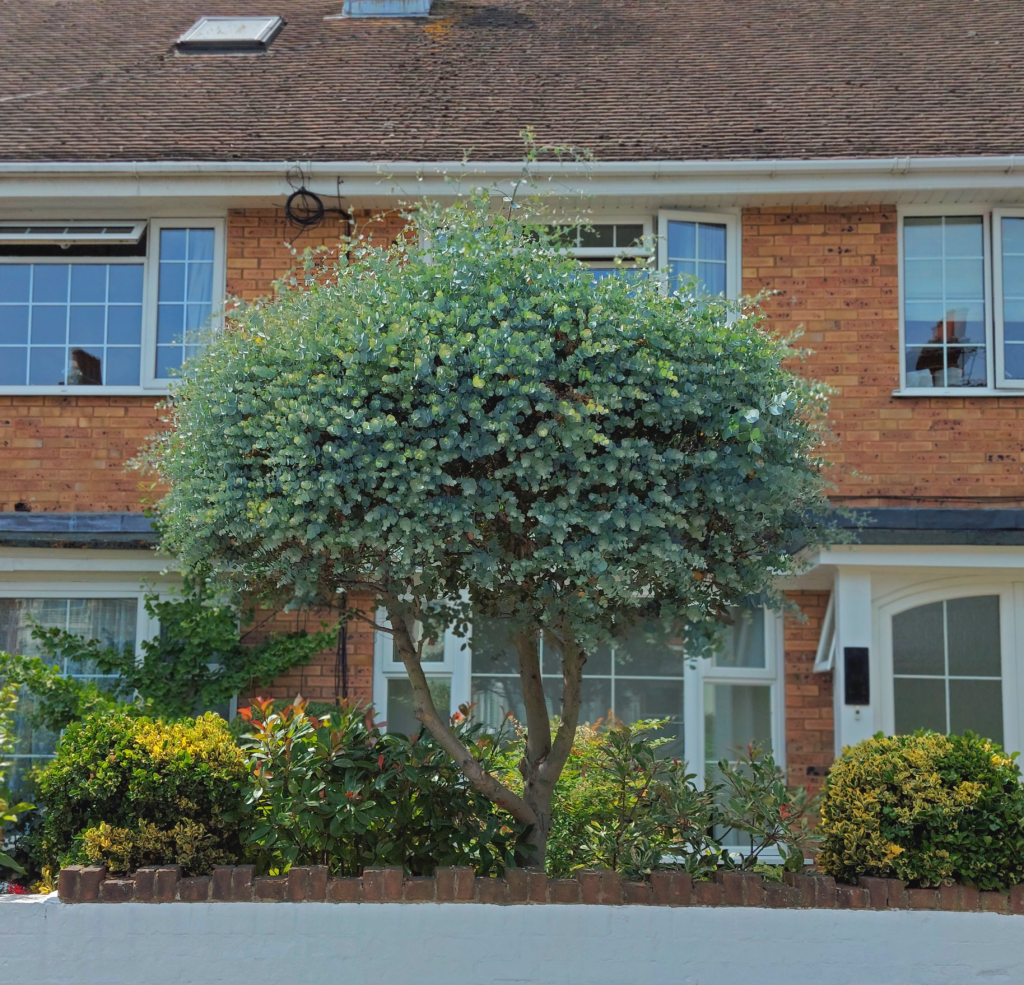
They can be managed in a variety of ways; shrub-on-a-stick, multi-stemmed-tree, bushy to the ground or grown au-naturel to full height. Many are very versatile and cosmopolitan in their growing requirements, and tolerant of being trained in several forms.
Some species are a little more site specific in their needs: e.g. the Snow Gums insist on having free-draining winter conditions, they don’t appreciate a soggy clay around their roots.
Before choosing your variety, you must assess three critical factors:
At what height do you require the privacy? In a typical suburban garden, this is usually from the top of the fence line (1.8m) up to about 2.4m to 4.5m.
The compact Eucalyptus varieties recommended below can easily be maintained at this height. You just have to be prepared to prune them once or twice a year, using standard secateurs or loppers, to keep them bushy. No special skills required. (Bonus: If you join our mailing list, we will email you at the exact right time of year to prune so you don’t even need to remember when to sally forth into the garden to do the deed!)
If you have chunks of limestone, there are a few Eucalypts that will tolerate these conditions too…see later
Ignore your Eucalyptus = growing feral = no screening = tears!
One of the greatest benefits of specific Eucalyptus species is their ability thrive in a wet clay soil. I cannot think of any other evergreen tree species that is remotely tolerant of a wet clay soil, let alone relish such conditions.
Deciduous Willows and Alders are often specified, but are only in full leaf for less than half the year. Furthermore, wet soils are breeding grounds for the dreaded Phytophthora ramorum – a highly deadly disease which enjoys a broad menu of over 150 plant species including Prunus and Leyland Cypress. Conifers, Laurel, Holly and Yew are certainly NOT tolerant of wet soils.
The table below outlines the best compact, hardy Eucalyptus varieties based on your soil type and preferred growth form:
Eucalyptus species or cultivar | Shrub-on-a-stick | Multi-stemmed Tree | Bushy to the ground | Green or Blue Foliage | Normal Soil | Free-draining Soil | Wet Clay* Soil | |
1 | Y | Y | almost | Blue | Y | Y | Y | |
2 | Y | Y | almost | Blue | Y | Y | Y | |
3 | Y | Y | almost | Blue | Y | Y | Y | |
4 | kybeanensis best as SOS | Y | Y | N | Green | Y | Y | Draining clay |
5 | Y | Y | almost | Green | Y | – | Y | |
6 | Y | Y | almost | Grey-blue | Y | Y | Y | |
7 | Y | Y | Y | Green | Y | – | Y | |
8 | Y | Y | N | French Blue | Y | Y | N | |
9 | Either pauciflora subsp pauci. ‘Mt Bogong’ OR pauciflora subsp pauci. ‘Mt Buffalo’ | Y | Y | N | French Blue | Y | Y | N |
10 | nichollii – minty aroma, feathery foliage | Y | Y | N | Sage- green | Y | Y | Draining clay |
Important variety notes to the chart above:
* Wet clay soils: Refers to clay that drains for part of the year, not permanent swamplands. For waterlogged sites, view our Swamp Gum Eucalyptus Selection. Eucalyptus camphora is an excellent swamp gum that can be trained as an SOS.
Soil pH for the above is assumed to be mildy alkaline through normal to acidic.
Chalk and Limestone Soils: If you have a highly alkaline limestone soil, the Snow Gum group (Eucalyptus pauciflora) will grow happily particularly if planted in well-prepared ground and fed with an occasional Iron Sequestrene plant food.
The Small-Leaved Kybean Gum (Eucalyptus parvula) is equally limestone tolerant, as is the larger growing Broad-leaved Kindling Bark (Eucalyptus dalrympleana). To enjoy E. dalrympleana as a sensibly-sized specimen, coppice or pollard every 5 years or so and grow it back up again, but I accept that doesn’t tick the screening tree box for a smaller garden.
** Genetic Dwarves: E. gunnii ‘Azura’ and E. gunnii ‘France Bleu’ are specially bred hybrid dwarves. Unlike their parents straight Eucalyptus gunnii, they do not have the genetics to grow into the classic 80ft monster.
When planting, ensure there is Absolutely NO GRASS for at least 1m diameter around the base of the tree, not even if you cut it, water it, feed it –Grass is a silent tree killer. For information on how to correctly plant a Eucalyptus check our Planting Guide
Pruning hard every mid-March may feel counter-intuitive, but you will be amazed by how many new shoots sprout from the bare wood. Simply pinch out the top 2cm of every new shoot in May, and each shoot tip will respond by producing four new shoots.
Timely pruning = More bushy shoots = more leaves = absolute privacy = happiness
After a few years of this formative training, you can easily maintain the shape using a standard mechanical hedge trimmer or hand shears. This will produce and admirable specimen of which you will be proud (and your neighbours will be in awe!)
Like any hedge or piece of topiary, if you fail to prune, the canopy will go rogue, open up and your privacy will evaporate like an ice-cube on a hot summer’s day. But this isn’t just Eucs, all hedge species will open up if ignored.
For more information, follow our Illustrated Pruning Guides
Watering your Euc for the first two years of its life in your garden is essential for deep root establishment; check our Eucalyptus Seasonal Watering Guide for precise seasonal quantities.
To fuel all that new growth generated after your pruning, apply our specialised Eucalyptus Smart Fertiliser in April, June and August for the first two to three years.
You planted your tree, pruned it for the first few years and then life got in the way. ‘Suddenly’ one day, you notice that your screening Eucalyptus has put on a little too much growth and is now waving at a house 2 streets away – not at all what you intended.
Panic not!
If you prefer a true, billowing hedge screen rather than individual trees, the Tasmanian Alpine Yellow Gum (E. subcrenulata) is exceptional for wet clay, retaining its lower foliage beautifully when trimmed into a flat-topped pyramid. Alternatively, E. ‘France Bleu’ and E. ‘Azura’ make fantastic, low-maintenance, billowing hedge screens.