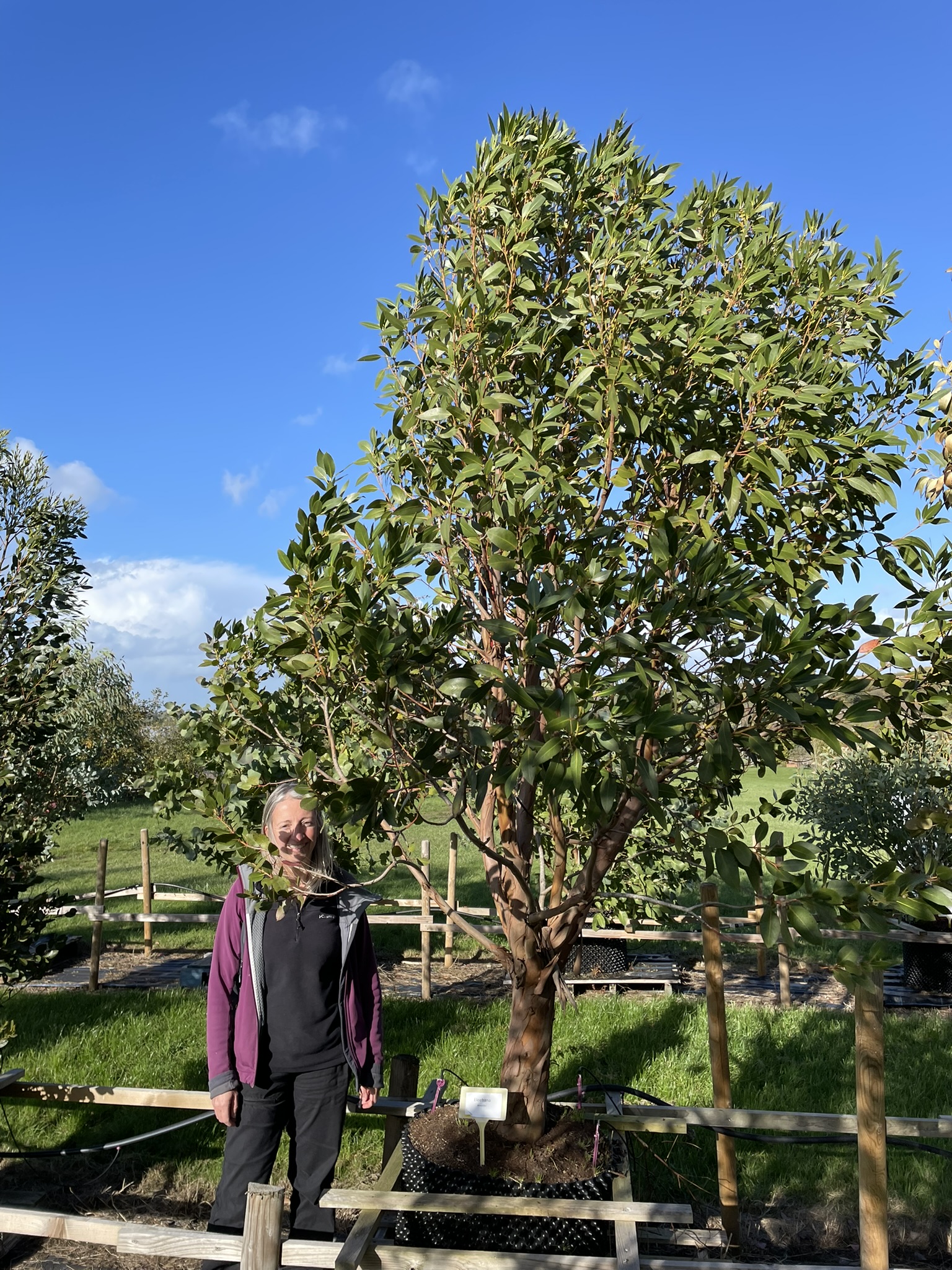
This specimen tree is aptly named ‘Eleebana’, the aboriginal term for Beautiful. Its’ bushy canopy and multi-stem shape is very nearly the classic child’s drawing of a tree – and belies its height of close to 3 metres. Planted in 2021, it has developed a sturdy girth of 28-30 making it the perfect tree to add to a landscape or garden and look like it’s been there for years.
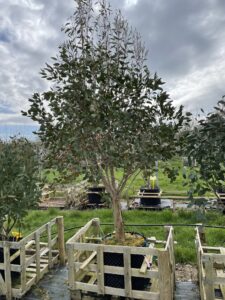
Eucalyptus subcrenulata ‘Eleebana’ in a 100 litre Air-pot Grafton Nursery Hardy Eucalyptus
Colloquial Australian Species Name – Tasmanian Alpine Yellow
Not your typical idea of a Eucalyptus, with its beautiful glossy apple green leaves, but it’s definitely one of our favourites. Eucalyptus subcrenulata is a good all round variety, which can be used in many different ways.
Shoots ‘n Leaves: Young shoots are crimson, bronze, then green.
Juvenile Foliage: Glossy deep apple green with red edges, deepening to dark apple green with time; the leaves are opposite, on square stems.
Adult foliage: Elongated, pendulous and a deep apple green.
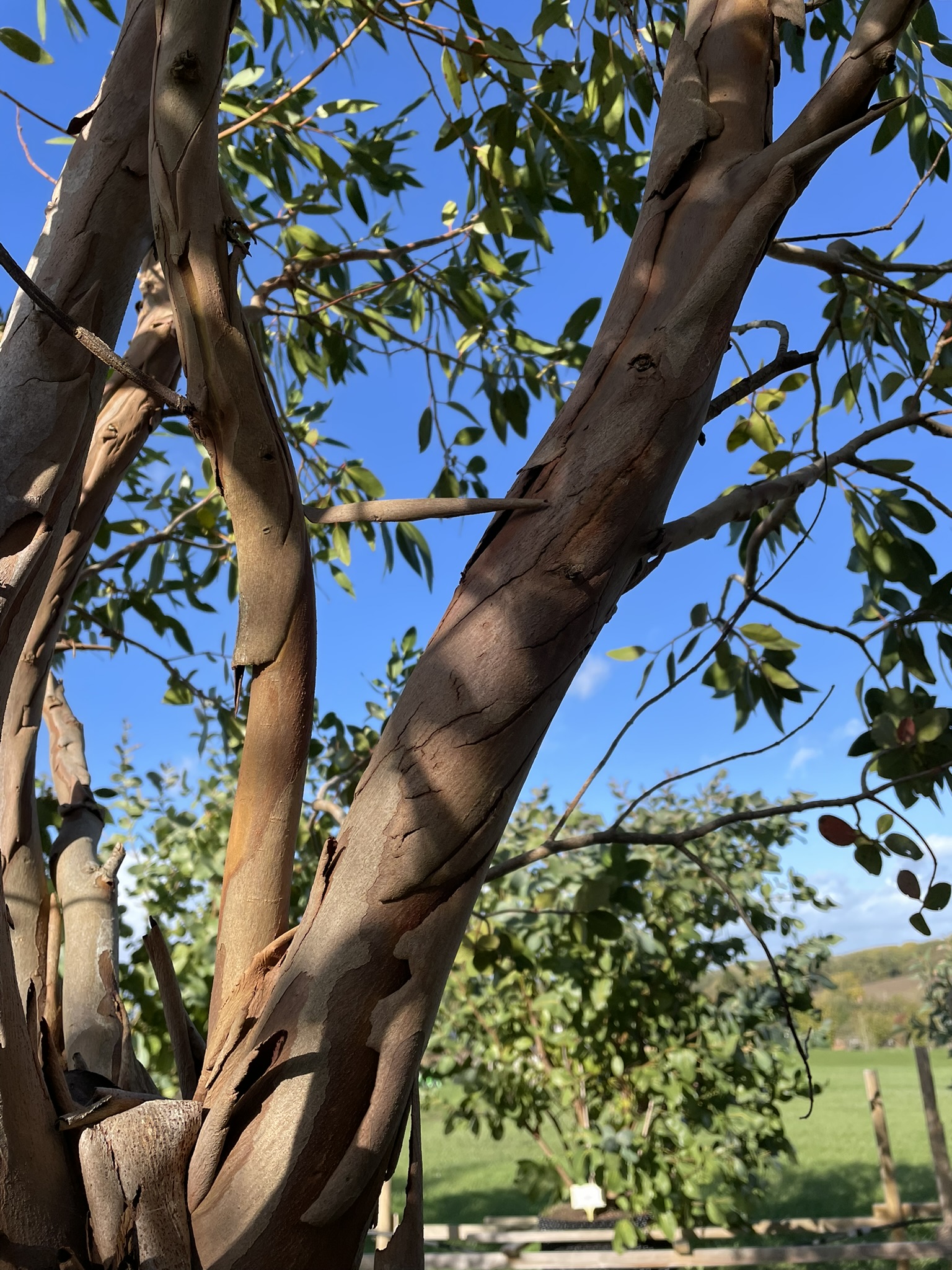
Bark: Beautiful bark with ‘scroll-work’ type pattern. Peels in coffee coloured vertical strips. When the bark sheds in July, a golden liquid amber coloured under-bark is revealed before turning olive green/coffee again. Looks very artistic after rain.
Flowers: White through to cream, in groups of 3. Our trees flower August onwards well into October – great for autumn foraging honey bees.
Leaf Aroma: Warm, strong and deliciously spicy when crushed.
Rate of Growth: Medium to Fast at 1-1.5 m per year.
Height in maturity, if left unpruned: after about 15-20 years, E subcrenulata could reach approximately 15 – 20m, although some specimens can attain a greater height under optimal conditions. Easy to keep smaller by regular pruning – March 18th and end of May.
If pruned, it can be trained to form a bushy screening tree, a lollipop standard or a multi-stemmed bush like a species rose or coppiced Hazel tree. Responds well to coppicing and pollarding, when done at the right time of year. For more information on the best way to prune read our Guidance Notes here
Hardiness: Good hardiness rating, root-system should be happy down to around -14 to -16°C, once mature. Hardiness increases with age.
Fabulous Specimen Tree for the wider landscape, arboretum collection or avenue planting and for the smaller, medium and larger garden. For quick and efficient establishment, follow our detailed planting instructions (SUPPLIED with EVERY TREE).
CARE ESSENTIALS: No grass, no weeds and a thick bark chip mulch, to a depth of 150 mm (6 inches) are essential to assist with good establishment. For more, see our guidance notes for growing specimen Eucalyptus in our Help and Advice section. For monthly emails on how and when to prune and care for your Eucalyptus, sign up to our Gumnut Club and we’ll send you the Bush Telegraph – it’s totally free and you can unsubscribe at any time.
Why would you want to do this?
To create:
REMEMBER: No grass, no weeds and a thick boring bark chip mulch, to a depth of 150 mm (6 inches) are essential to assist with good establishment. Our research trials have demonstrated that grass around the trunk of Eucalyptus prevent the trees from quickly establishing and can completely stop them from growing.
– Good shade tree for livestock to stand under. Eucalyptus provide a cool environment for horses, cattle, llamas, sheep to shelter from the sun on hot days, as the mass evaporation of water through the leaves creates a cool shady canopy beneath. Good choice for silvopasture.
– Green foliaged species, which looks for comfortable and not ‘foreign’ in a rural setting – reminiscent of Willow Trees
– Bees. All Eucalyptus produce flowers with nectar and pollen, but this species has prolific flowers making it a real draw for honey bees and other pollinators in late summer when forage is scarce
– Habitat creation and Game Cover: this species lends itself to providing good trouble-free habitat creation for wildlife and game cover, when planted in groups. At the nursery, the Goldfinches enjoys nesting in our subcrenulata hedge.
Birds enjoy roosting in Eucalyptus trees and Pheasants like rootling around underneath them.
– Chickens: The shredded foliage of E subcrenulata is excellent at keeping Chicken nest boxes and hen houses free of red mites, which detest the presence of Eucalyptol. I used to line our Chicken boxes with shredded leaves, strew the floor and pile up the spindly branches for the chickens to make nests. It was all great till the foxes moved into the next field L
– Growing on the Coast: E subcrenulata is tolerant of cold exposed conditions and salt laden winds, once mature in the ground. Newly planted trees may require a wind break shelter using something like horticultural fleece or sail cloth, for their first winter in the ground with you.
There is a successful plantation of E subcrenulata in sight of the sea at Wadebridge in Cornwall
– Drying up intermittently wet soils. Hailing from damp hillsides in Tasmania and soggy valley bottoms in the wild, E subcrenulata does prefer a moisture retentive soil and does well at drying up a wet UK soil.
Dry up wet ground that intermittently floods, gain remedial treatment for winter boggy ground or soil which suffers from unwanted ponding. If you have un-usable winter-marshy pasture, our research has shown that installing a small plantation of swamp gums will help dry up an area of ground over a period of time and give you a crop of firewood logs too, if coppiced every few years; certainly worth giving it a try. Just bear in mind that these trees are not ‘aquatic’ and will do best if the ground drains somewhat for part of the year. Furthermore, coppicing would need to occur in rotation, so that you didn’t lose all of the trees and therefore the pumping of water in one go.
– Sustainable Drainage Systems aka SUDS: an 18m row of E. subcrenulata has been successfully used at one end of our nursery to absorb the overflow water from our irrigation system. Planted at 1.5m spacing, around 2014, the trees are pollarded down to around 2m every 2-3 years and allowed to grow up to around 6m (15-20 feet) in between. The water used to pond around their ankles every winter, but the ground around them is now dry and passable even after prolonged, heavy rain. They have retained their foliage down to almost ground level and now form a robust hedge screen for the nursery.
E. subcrenulata will draw on drain water percolating into swales or similar. Coppice or pollard every few years if you need to control the overall height of the trees. Eucalyptus draw on ground water for twelve months of the year, unlike willows, which lie dormant for 5 months through the winter.
– Tolerant of cold and exposed growing environments inland: E. subcrenulata will grow in open fields and pasture, once established. Newly planted trees may require a wind break shelter made from horticultural fleece or sail cloth, for their first winter in the ground with you; this very much depends on the level of exposure.
| Weight | 100 kg |
|---|---|
| Dimensions | 100 × 100 × 3000 cm |